Hypnaut Audio / Closed Beta / 2026

Prosperity Synth.

Prosperity Synth turns samples into playable granular instruments. A polyphonic granular synthesizer built around the Prosperity engine. Two independent granular engines per voice, a spectral warp and morph section, dual state-variable filters, and a diffusion reverb tail, all on one panel. Six modulation sources route freely across the signal path. The instrument covers a wide range: smooth evolving atmospheres and textural pads, complex layered sounds, and heavily glitched, fragmented, or distorted patches. Up to 8 voices with optional unison stacking.

StatusClosed beta
FormatsVST3 / AU
PlatformsmacOS / Windows
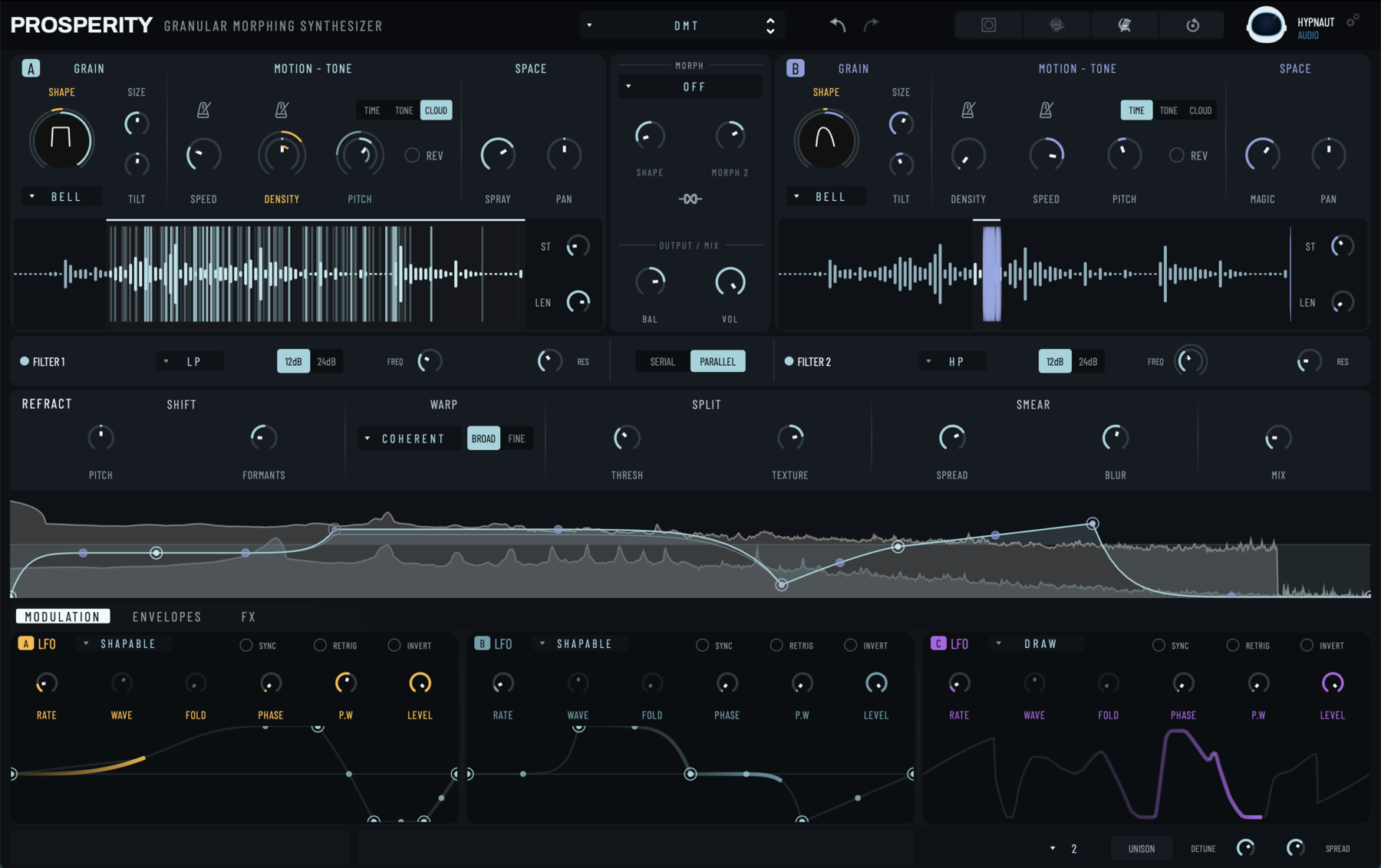
Prosperity Synth full plugin interface

Synthesizer

A complete granular signal chain, per voice.

Where Prosperity FX processes incoming audio, Prosperity Synth runs the same granular engine from a loaded sample. Each voice runs a dedicated instance of the full signal path: dual granular engines reading a loaded sample, a spectral warp curve and FX section, two filters in series or parallel, and a shared diffusion reverb tail. Three LFOs and three envelopes provide per-voice modulation. The depth of interaction between the warp curve, engine grain parameters, and filter routing gives the instrument a wide range , from stable, sustained tones and smooth atmospheres to layered shifting textures and heavily processed patches that sit closer to granular sound design than conventional synthesis.

The whole signal path, one screen.

Every stage from grain generation to reverb tail is visible and editable without navigating subpanels or menus. The relationship between the warp curve, engine settings, and filter response is immediately audible, which makes detailed sound design and iterative experimentation practical rather than procedural.

Prosperity Synth granular engines

Architecture

Signal path.

Dual Granular Engines and Morph
A

Dual Granular Engines

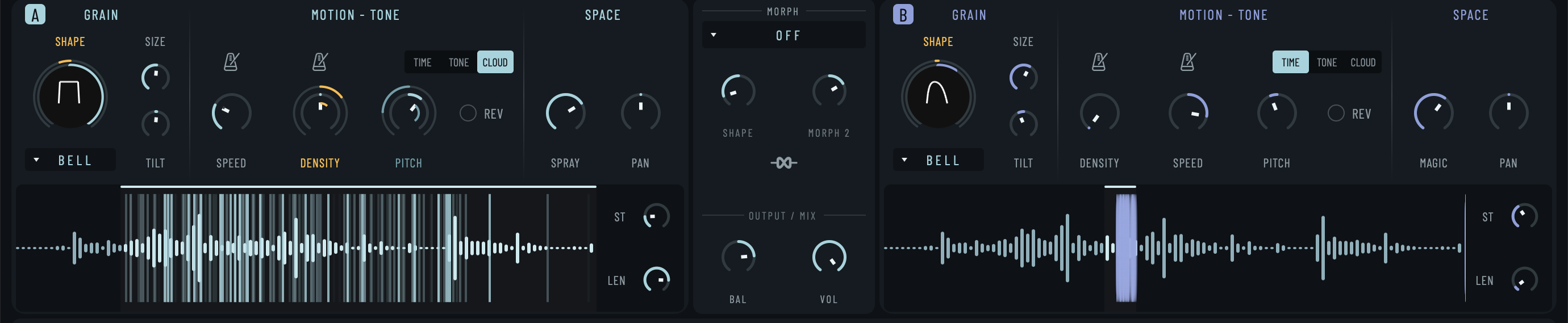
Two independent granular engines per voice, each reading a loaded sample through its own grain processing chain. Per-engine controls cover Grain Shape, Size, and Tilt for envelope shaping; Motion parameters for Density and Speed; Pitch transposition; and Space settings for stereo placement and scatter. A live waveform display with independent ST/LEN loop markers defines the playback region for each engine. The Morph column between them blends the two spectral outputs in real time across four morph types, with independent balance and output volume. Engine divergence and morph position drive most of the instrument's timbral variation , from coherent sustained tones to fragmented, spectrally complex layers.

Each engine now runs in one of three granular modes, set per engine so the two halves of a voice can read the same sample in completely different ways:

  • Time Engine , motion and texture. Time Engine is the classic scatter granulator: a coherent read head that can be slowed, frozen, reversed or stretched independently of pitch. It preserves the source's character while letting you time-stretch, glitch and re-pitch it, so it excels at evolving pads, risers and transitions, rhythmic stutters (with DENSITY and SPEED tempo-synced), and general sample mangling. With DENSITY low you hear individual grains for stuttery, rhythmic effects; with DENSITY high it blurs into a continuous, organic stream that keeps the timbral fingerprint of the loop.
  • Tone Engine , pitch and instrument. Tone Engine locks playback to the played note via overlap-add resynthesis, turning any loaded sample into a fully tonal, polyphonically playable instrument. It tracks the keyboard cleanly and holds steady pitch regardless of the source's original tuning, making it ideal for melodic leads, plucks, organ- and string-like sustains, and basses, where you want the timbre of a sample but the tuning and stability of a synth. As an Engine B morph source it contributes a pitch-locked spectral fingerprint that morphs against Engine A. Reach for it whenever the patch needs to be played rather than triggered.
  • Cloud Engine , atmosphere and diffusion. Cloud Engine trades coherence for density: a swarm of randomised grains that smears the source into a soft, three-dimensional texture. Because read position, pitch, amplitude, size and direction are diced per grain, it naturally produces granular-reverb washes, shimmering ambiences, frozen drones and evolving sound beds , the more SPRAY and DENSITY you add, the more the original sample dissolves into atmosphere. It is the mode for ambient and cinematic textures, pad design, transitions and tails, and anywhere you want a sample to become a place rather than a note. Pair it with the diffusion delay/reverb and slow LFOs on ST/LEN for endlessly drifting backdrops.
Warp Curve Editor and Spectral FX
B

Warp Curve Editor & Spectral FX

An interactive XY display that remaps spectral content after grain reconstruction, drawn over a live spectral view of the voice output. Every node and handle is modulatable. The Spectral FX row adds Pitch and Formant shifting, Spread, a harmonic/residual Texture control with threshold, time-smearing Blur, and a dry/wet Mix. Warp algorithm and frequency-domain mapping mode are selectable. Moderate curve adjustments shape tone and formant character; steep remappings combined with Texture and Blur routing produce fragmented, glitched, and heavily processed results that vary with each grain burst , pushing into distortion and artefact territory without a separate effects chain.

Three LFOs Envelopes
C

Modulation

Three LFOs, each switchable between Classic (continuously morphing waveform: Rate, Wave, Fold, Phase, P.W, Level), Shapable (editable multi-segment curve), and Draw (freehand waveform), with host sync and retrig support. All six sources assign to parameters across the engines, warp, morph, and filters via ring controls, with independent depth per assignment. Dense modulation routing, multiple fast LFOs into warp curve nodes, filter cutoff, and engine grain density simultaneously, is where the instrument generates unstable, glitching, and rhythmically complex textures.

Three envelopes: ENV 1 and ENV 2 are freely assignable; AMP shapes each voice's output level directly. Both support Classic ADSR and Shapable curve modes.

Dual State-Variable Filters
D

Dual Filters

A per-voice dual state-variable filter. Each filter selects between LP, HP, BP and Notch modes with 12 dB or 24 dB slope, with independently modulatable FREQ and RES. Serial mode stacks the filters in sequence; Parallel mode sums their outputs. At moderate settings they handle standard spectral shaping; at high resonance with modulated cutoff they contribute to the instrument's more aggressive and rhythmically unstable output.

Hive diffusion delay and reverb
E

Hive , Diffusion Delay / Reverb

A diffusion-based delay and reverb at the output of the signal chain. Delay time is tempo-syncable; Feedback sets repeat count; Low Cut and High Cut filter the recirculating signal. Size and Diffusion control reverb density , lower diffusion gives clean, separated repeats while higher settings build a continuous, self-similar tail. Width sets the stereo spread. A single Mix control sets the wet/dry balance.

F

Preset Browser

A built-in preset browser for saving, loading, and organising patches. A factory preset library covering the instrument's range , from clean pads and evolving atmospheres through to complex textural layers and heavily processed patches , is in development and will ship with the release build. Users can save their own presets and organise them into named folders.

Voices and Unison controls
G

Voices & Unison

Up to 8 simultaneous voices, each running the full signal chain above. UNISON stacks additional detuned copies of each voice: DETUNE sets the pitch spread between copies and SPREAD distributes them across the stereo field. Voice count is adjustable to balance polyphony and processor headroom. Notes beyond the voice limit steal the oldest active voice.

Software Licensing

Prosperity Synth will be sold as a perpetual licence. Musicians and producers should be able to own the tools they depend on and retain access to the sounds used in their projects.

Hypnaut Audio may offer optional subscription plans in the future if the user base asks for them, but perpetual licensing will remain the default.

Closed beta

Limited early access.

We are looking for producers, sound designers, film composers, and experimental musicians working with complex, layered, or textural sound who want early access to a granular instrument built for that kind of work.

Beta slots are limited and reviewed manually. Accepted participants receive a free full licence when Prosperity Synth releases.

FAQ

Practical notes.

Beta

How do I apply for the Prosperity beta?+
Fill in the form on this page. We review applications manually and prioritise people who describe how they actually work — what music they make, what they're trying to achieve. Beta slots are limited.
What do I get if I'm accepted into the beta?+
Access to Prosperity before public release, direct contact with development, and a free full licence when Prosperity launches commercially.

General

How do I get support?+
Use the contact form on this page. We're a small team and read every message personally. For ISS migration questions, select "Account Migration" as the subject — it routes straight to the right place.
Are you working on anything besides Prosperity?+
Yes, but we don't announce things until they're close to done. Subscribe to the beta list to hear first.

Product

When is Prosperity available to buy?+
We don't have a public release date yet. We'll announce via the mailing list. Sign up for the beta to be first in line.
Is Prosperity a subscription?+
No. Hypnaut Audio plugins are one-time purchases. You own what you buy. We don't believe in renting software.
What platforms and formats does Prosperity support?+
Prosperity ships as VST3 and AU on macOS and Windows. Minimum CPU: Intel Core i5 or Apple M1. Sample rates 44.1 kHz – 192 kHz. No additional samples or libraries required.
Does Prosperity require an internet connection to run?+
No. Once installed and activated, Prosperity runs entirely offline. We don't phone home, collect usage data, or require account authentication to open a session.

Contact

Get in touch.

Questions, feedback, press enquiries, or just want to say hello. We read everything and respond personally.

About Hypnaut Audio

Creative audio tools for musicians, producers, and sound designers, centered on texture, sound design, and musical exploration.